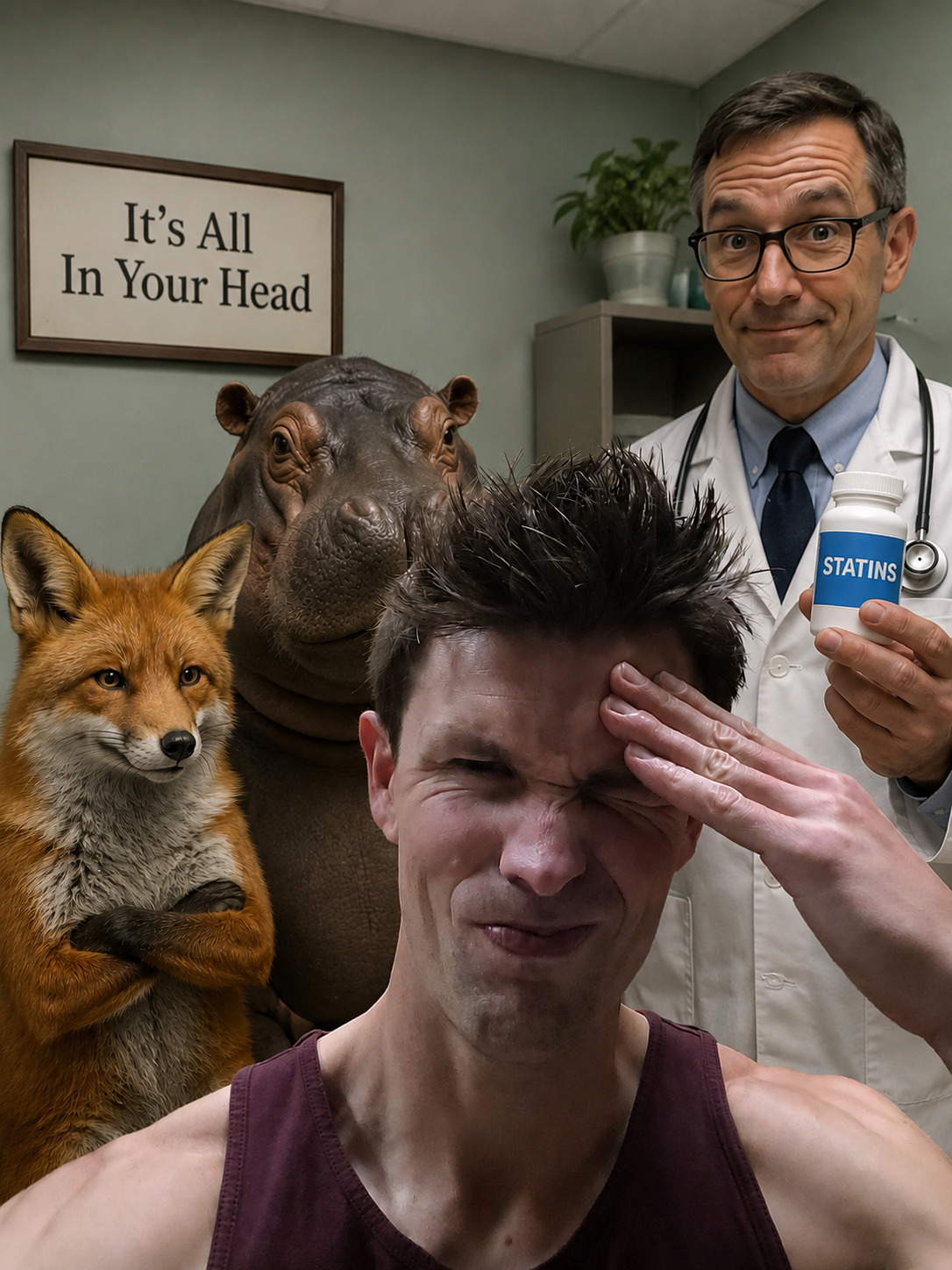
A interesting NEW ARTICLE on mechanisms for statin associated muscle symptoms (SAMS) has been making headlines, and in my humble opinion, it further builds on some of the existing literature attempting to describe the phenomenon. And before I present my framework, which is a UNIFIED MODEL of deficient isoprenoid synthesis, decreased glucose utilization, and impaired mitochondrial function, I think it’s worthwhile to provide some history of my personal curiosity regarding the topic.
As many of you know, my first Doctorate was in Physical Therapy, and I was blessed to see thousands of patients in outpatient orthopedic rehab. And ultimately, there are 2 types of rehab patients:
- People with a little bit of dawg in them.
- People who declare within 17 seconds of meeting you that they “Have a high pain tolerance.”
The second type of patient is generally an Executive Member at every local pharmacy and has an unusually robust knowledge of pharmacology. It requires prayer, care, and the Power of Redirection to navigate that messy minefield of both personal biases and undetonated demons for those folks.
The first type of patient tends to be a straight-shooter. And I saw dozens of patients who were quite reasonable and fairly tough who complained of muscular symptoms after starting statins.
So I plunged headlong into the literature and waded through countless articles in which the essential summary was, “It’s all in their heads…except for the rare people who start peeing out cherry cola and can’t walk” after taking statins. As someone who has had rhabdomyolysis on multiple occasions and who actually listens to people, I was dissatisfied with this explanation.
And I encountered THIS ARTICLE showing that pro athletes can rarely tolerate statins. And I found this one that showed decreased oxidative phosphorylation in complexes III and IV of the mitochondrial electron transport chain, even in asymptomatic people on statins. And I learned that statins decrease guanidinoacetate methyltransferase (GAMT), the committed enzymatic step in creatine synthesis. And I found a bunch of articles showing an increased risk of new-onset diabetes with statins.
But as I became fascinated with the biochemistry, the hand-waving among the medical establishment seemed to intensify, and I felt many were trying to make us “blow off” the plausible mechanisms. Because, after all, statins do a LOT of good things and have more data in reducing cardiovascular events than any other drug class. But when I heard the repeated rhetoric of “Diabetes doesn’t matter” and “Muscle aches aren’t as bad as having a heart attack,” it further inspired me to figure out the truth.
Two things can be true at once:
- Statins have legitimate and biochemically plausible toxicities that can help us better understand the side effect profile.
- Statins are a useful tool in the right context for mitigating risk of cardiovascular events.
Ok, so now the moment you’ve all been waiting for…a coherent mechanistic framework for statin-associated muscle symptoms! To summarize, decreased isoprenoid synthesis leads to impaired glucose utilization in skeletal muscle. Impaired glucose utilization in skeletal muscle leads to decreased mitochondrial function and elicits a “Danger Signal,” resulting in autophagy and proteostasis. And this might make your muscles hurt. Your brain might hurt a little, too, but stay with me as we discuss these mechanisms!
- Statins not only decrease cholesterol synthesis, but they decrease the synthesis of ISOPRENOID INTERMEDIATES such as farnesyl pyrophosphate (FPP) and geranylgeranylpyrophosphate (GGPP). These lipid intermediates play critical roles in prenylation, which is a form of post-translational protein modification.
- Basically, you have a protein, and PREnylation helps equip the protein with a Prefontaine-esque will to accomplish a variety of physiological functions (I coach Cross Country and Track, and Steve “Pre” Prefontaine is a legendary figure in running circles). If you have diminished prenylation, then you probably aren’t going to “win the race” when it comes to certain biological processes.
- GGPP, in particular, is important in several cascades including Rho and TAZ/IRS-1, and the end result of these signaling pathways is GLUT4 translocation to the cell surface of the myocyte and adipocyte (insulin-dependent tissues). Ergo, statins decrease GGPP. GGPP increases glucose uptake into insulin-dependent tissues. Less GGPP, less glucose uptake. Blood sugars could rise. Glycolysis is impaired. Less glucose makes its way down to pyruvate and the pyruvate dehydrogenase complex which usually takes pyruvate into the Krebs Cycle…which then would normally rev the Electron Transport Chain. With this decreased flux, we see elevated PDK4, a marker of impaired substrate utilization (and statin-induced myalgias). And yes, ALL OF THOSE THINGS are mentioned in this new study.
- Impaired glycolysis results in a “Danger Signal” to muscle, activating the NLRP3 inflammasome. A nuclear transcription factor called FOXO1 is activated, which results in the upregulation of atrogin-1. Yep, atrogin, like ATROPHY. Muscles aren’t happy.
- FOXO1 is a positive regulator of AUTOPHAGY, or cellular housekeeping, and THIS STUDY also shows statins do regulate FOXO1. If there is a mess in the arterial wall, some intimal housekeeping would seem rather appropriate. However, if FOXO1 is activated in skeletal muscle, atrogin-1 is upregulated. Perhaps if you’re busy using the Statin Service to clean your house (autophagy), you may not have as much time or energy to use your gym membership (muscle building).
- Additionally, decreased prenylation decreases the activity of Yes-associated protein (YAP). YAP is involved in the regulation of the Hippo pathway; if a Hippo is sitting on you, you probably are going to have a hard time building muscle. Conversely, too much YAP in various tissues can increase cell proliferation and magnify risk of certain cancers. So there is a sweet spot, but statins decrease YAP. It’s hard to say YES to a gym membership when there’s a Hippo sitting on you.
With adequate prenylation, keeping Hippos and FOXO1 foxes in check seems to be much easier. But if this balance is perturbed, then it’s possible that blood sugars and muscle aches could both be rising.
Statins do a lot of good things. Statins potentially do some things that we don’t love. Listen to your patients. Clearly communicate up-front the pros and cons of each treatment and the rationale for the therapeutic intervention. Consider creatine and combination therapy as potential ways to mitigate myalgias; there are many available non-statin options if you need to live in a safer Lipid Neighborhood. And remember to always blame your patients when they complain of side effects “No one cares how much you know until they know how much you care.”