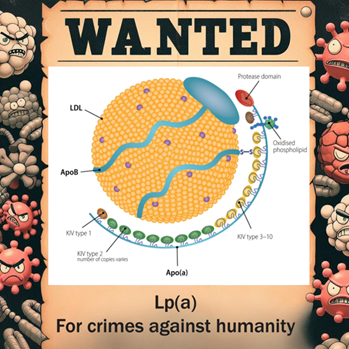
It has been well-recognized that having too many Lp(a) “Felons” in your Lipid Neighborhood is associated with increased risk of heart attacks and calcific aortic stenosis (among other things), but a recent study of over 66,000 US adults with Lp(a) levels >50 mg/dL showed a 33% increased risk of mitral annular calcification as well! (The mitral annulus is a saddle-shaped ring that helps streamline bloodflow between the left atrium and ventricle). However, another related study presented at the American Cardiology Conference showed no association between elevated Lp(a) and atrial fibrillation/atrial flutter, so at least we don’t need to add those crimes to its already extensive rap sheet.
So why do the Lp(a) felons promote calcification in the vasculature? Well, saddle up…if you don’t hold on tight, you might just get bucked off this Physiology Horse!
-The vascular interstitial cells (VICs) have an Lp(a) receptor called MSFD5. And interestingly, genetic variants that don’t effectively manage this MSFD5 “route of entry” are associated with increased aortic stenosis, while in vitro studies suggest less calcification when the MSFD5 security is tightened.
-However, recall that Lp(a) carries OXIDIZED PHOSPHOLIPIDS…and these oxidized phospholipids are enzymatically modified into something called lysophosphatidylcholine (LPC) by the enzyme Lp-PLA2 (some of you out there are familiar with that one as a biomarker, which is another interesting discussion). Then, another enzyme carried on Lp(a) called AUTOTAXIN converts the LPC into lysophosphatidic acid (LPA). Yes, we now have LPA on Lp(a)…this is why people throw their hands up and study more straightforward subjects like nuclear physics.
-So this LPA on Lp(a) upregulates something called bone morphogenetic protein-2 (BMP-2), which, somewhat predictably, stimulates an osteoblastic (bone-forming) cascade in the vasculature.
Bone in the aorta? Bone in the mitral valve? Probably not ideal. And that’s one of the many reasons why preventive clinicians have a bone to pick with Lp(a) as we continue researching the best ways to mitigate the residual risk associated with Lipid Neighborhood Felons!