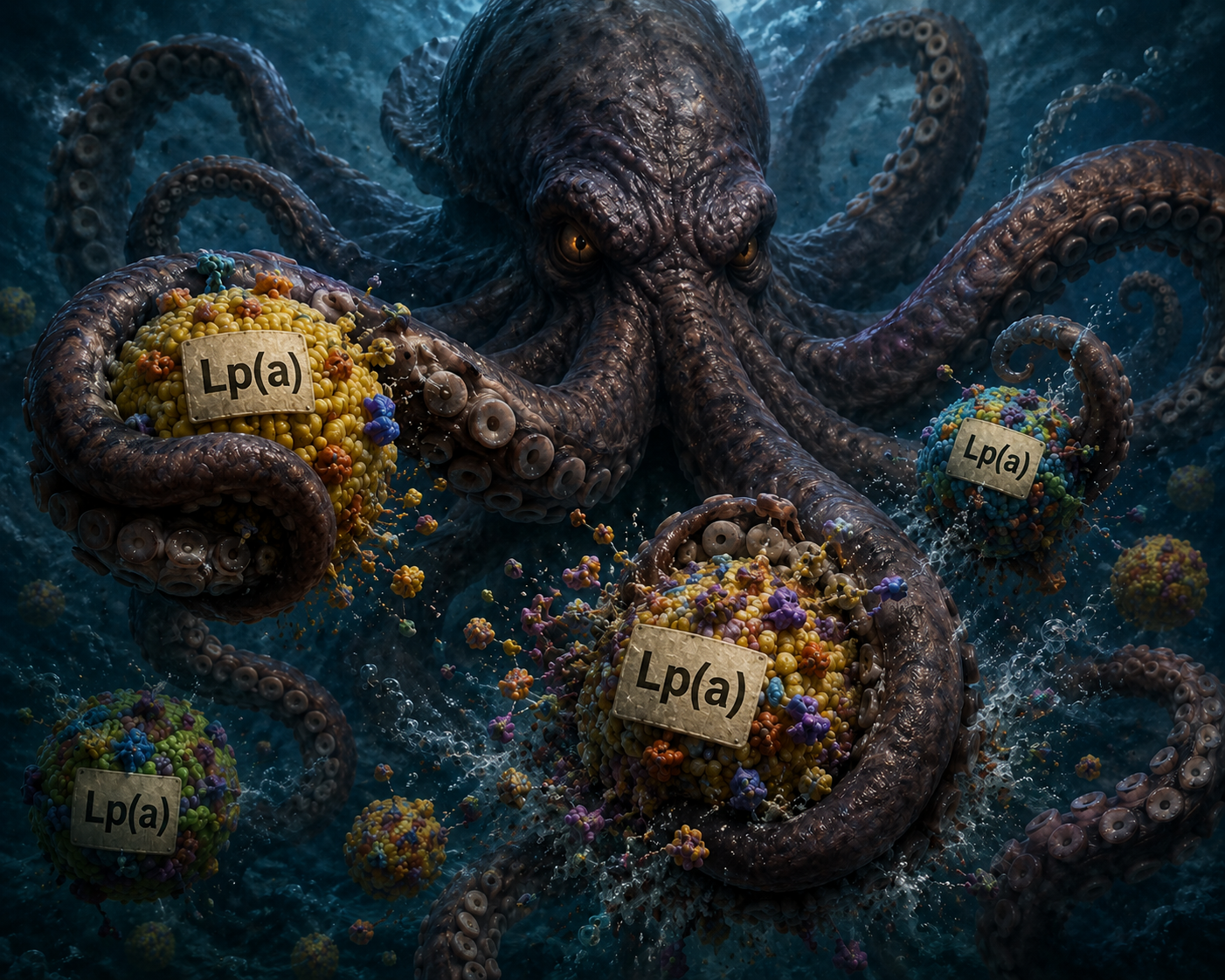
It’s an exciting time for Lipidology because there may finally be a medication on the horizon specifically for people who “picked the wrong parents” when it comes to Lp(a), the notorious “Felon of the Lipid Neighborhood.” (You can get some background on Lp(a) HERE). Various agents (mostly anti-sense oligonucleotides or siRNAs) are in development, but today’s topic is an update on “What’s Happenin’ with Muvalaplin,” an oral Lp(a) “assembly inhibitor.”
The most recent Phase 2 trial of Muvalaplin was named the KRAKEN study. You can remember this because if you’re swimming in a segment of the pool with a Kraken Sea Monster, it would probably be a good idea to “Move a Lap Lane” (it’s a stretch, but I bet you won’t forget now)!
So what is the mechanism of this “assembly inhibitor?” Instead of “shutting off the faucet” of Lp(a) production in the liver like the ASO and siRNA approaches, Muvalaplin inhibits the non-covalent binding of apo(a) to ApoB-100 via lysine residues on Kringle domains KIV-7 and 8. I like to think of it as “calling off the engagement intracellularly” prior to the “marriage,” which is a covalent bond between KIV-9’s cysteine and ApoB-100 on the mature Lp(a) particle.
But the consequence of this approach is that free apo(a) and some drug-bound Lp(a) ends up being secreted rather than a mature Lp(a) particle where apo(a) is bound to ApoB. This necessitated the creation of a new, not yet validated assay to measure intact Lp(a). Given the additional presence of apo(a) bound to Muvalaplin and free apo(a) unbound to anything, this measurement is needed to truly assess this agent’s efficacy in reducing Lp(a). So in Phase 2, intact Lp(a) was decreased 86%, but free apo(a) not bound to an ApoB particle increased by 337.3%!
So what are the consequences of increased free apo(a)? Well, in vitro studies show that apo(a) inhibits fibrinolysis (leads to greater likelihood of clots not dissolving appropriately). So that’s not good. But in recent post-hoc analysis of the KRAKEN study, there was no correlation between free apo(a) and eGFR, hs-CRP, or plasminogen activity. This seems encouraging, although there are many factors involved in clot formation and dissolution.
So will Muvalaplin help people move to a safer Lipid Neighborhood, or will a Clotting Kraken inadvertently be liberated to wreak havoc on the Fibrinolytic Friends in your physiologic dwelling? We will have to wait and see!