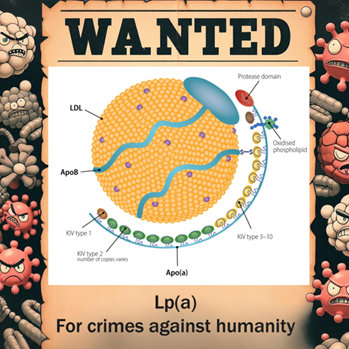
Cholesterol Guidelines recommend checking for Lp(a) “Felons in Your Lipid Neighborhood” AT LEAST ONCE in a person’s lifetime. We have discussed the effect of statins and other medications on Lp(a) levels in Chapter 6 of THIS BOOK and in THIS ARTICLE, but the other common situation to consider re-checking Lp(a) levels is after the MENOPAUSAL TRANSITION, which is supported by THIS NEW ARTICLE.
Among 415 pre-menopausal women in the UK BioBank Dataset who subsequently went through “The Change,” 56% of women who were initially in the “Intermediate Risk Range” of 75-125 nmol/L prior to menopause ended up being re-classified in the “High Risk Range” of >125 nmol/L after menopause. This group, on average, experienced an average increase in Lp(a) of ~35 nmol/L. These results were stated as consistent even among those receiving Hormone Replacement Therapy (HRT), although the specific details were not conveyed in the paper (aside from this group being mentioned as having a small sample size).
That “Gray Area” Intermediate Risk Range showed some additionally interesting findings, even in the absence or presence of Gray Hair (that was terrible). But 29% of women who remained pre-menopausal AND 28% of those who were post-menopausal at baseline also progressed to a “High Risk Range” on repeat testing, meaning their initial bloodwork showed Lp(a) levels of 75-125 nmol/L, but increased to >125 nmol/L when tested again. This is in line with other studies showing that, while Lp(a) is primarily genetically determined, there is greater intra-individual variability than once appreciated, further adding to the Enigmatic Aura of these lipoproteins.
Estrogen suppresses the true basal production rate of Lp(a), so when this is lost after menopause, Lp(a) levels can increase significantly. Menopause is criminal for many reasons, and one of those reasons is the potential increase in Lipid Neighborhood criminals when nature moves you to a new hormonal address.
Check Lp(a). And if you’re in that Intermediate Risk Range, maybe check it again, particularly after menopause😊