In the middle of this recent article on ketogenic diets and blood cholesterol levels, the recently discovered hormone cholesin was mentioned. (This article speculated that those on a ketogenic diet experience an increased degree of intestinal cholesterol absorption, which I believe is mechanistically correct…stay tuned for our upcoming article that further fleshes out these concepts)!
This additional cholesin pathway speaks to HOW TIGHTLY intracellular cholesterol is regulated in the body. Not enough cholesterol? Incompatible with functional cells. Too much cholesterol? Toxic, and your cells explode! Ergo, there is an incredibly elegant system of checks and balances that ensures adequate levels of cellular cholesterol.
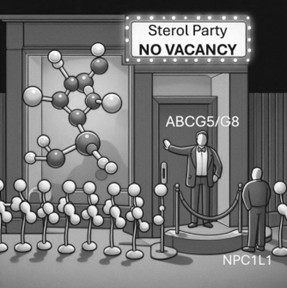
Ok, so hopefully you are familiar with NPC1L1, the Ticket Taker to the cholesterol party in your gut, and the Bouncer ABCG5/G8 that evicts excess sterol partygoers if things get a little too rowdy. (The details can be found in Chapter 5 of The Home Security System and the Lipid Neighborhood).
And on the liver side of the ledger, typically the seesaw of cholesterol production and absorption is regulated by SREBP2. If there is increased absorption, there tends to be less cholesterol production, and vice versa. And SREBP2 upregulates both LDLR (which pulls cholesterol into the liver) and HMGCR (dictates cholesterol production). If there isn’t enough cellular cholesterol, SREBP2 tells your liver to make more and pull more in. If there is too much cholesterol or a state of increased absorption, SREBP2 chills out and downregulates LDLR and HMGCR.
So where does cholesin fit in to the picture?
Well, when you ingest some cholesterol from the diet (or presumably when there is any cholesterol in the gut), the gut cells respond by producing cholesin (Everyone is familiar with other gut hormones, primarily incretins like GLP-1, so it’s nice to mix in a little Lipid Love) . Cholesin, being a hormone, doesn’t like to stay in one place, so it migrates over to the liver and binds to GPR146 (G protein-coupled receptor signaling pathways result in a cAMP-pKA-mediated phosphorylation cascade…I tell my students that if you go Camping with a Pikachu, something magical, in this case gene transcription, will happen)!
GPR146 usually will activate SREBP2…but not if cholesin binds it first! So cholesin, via binding GPR146, “distracts” GPR146 from activating SREBP2. The end result of this is less cholesterol synthesis and less VLDL secretion. And (minor spoiler alert), our mechanistic model in people with ketogenic diet-induced hypercholesterolemia (Lean Mass Hyperabsorbers) proposes that SREBP2 is relatively downregulated while a state of cholesterol hyperabsorption predominates.
Adding another layer of intrigue to the story is that knocking out GPR146 seems to protect animals against atherosclerosis, including those without functional LDL receptors, making GPR146 a potential future therapeutic target for those with Homozygous Familial Hypercholesterolemia (HoFH).
So anyway, hopefully this gets you excited for our upcoming paper as well as potential innovations for folks who “picked the wrong parents” when it comes to their genetic Lipid Neighborhoods. And hopefully you continue to be awestruck at the Amazing Human Machine…and most of all, the Master Engineer😊