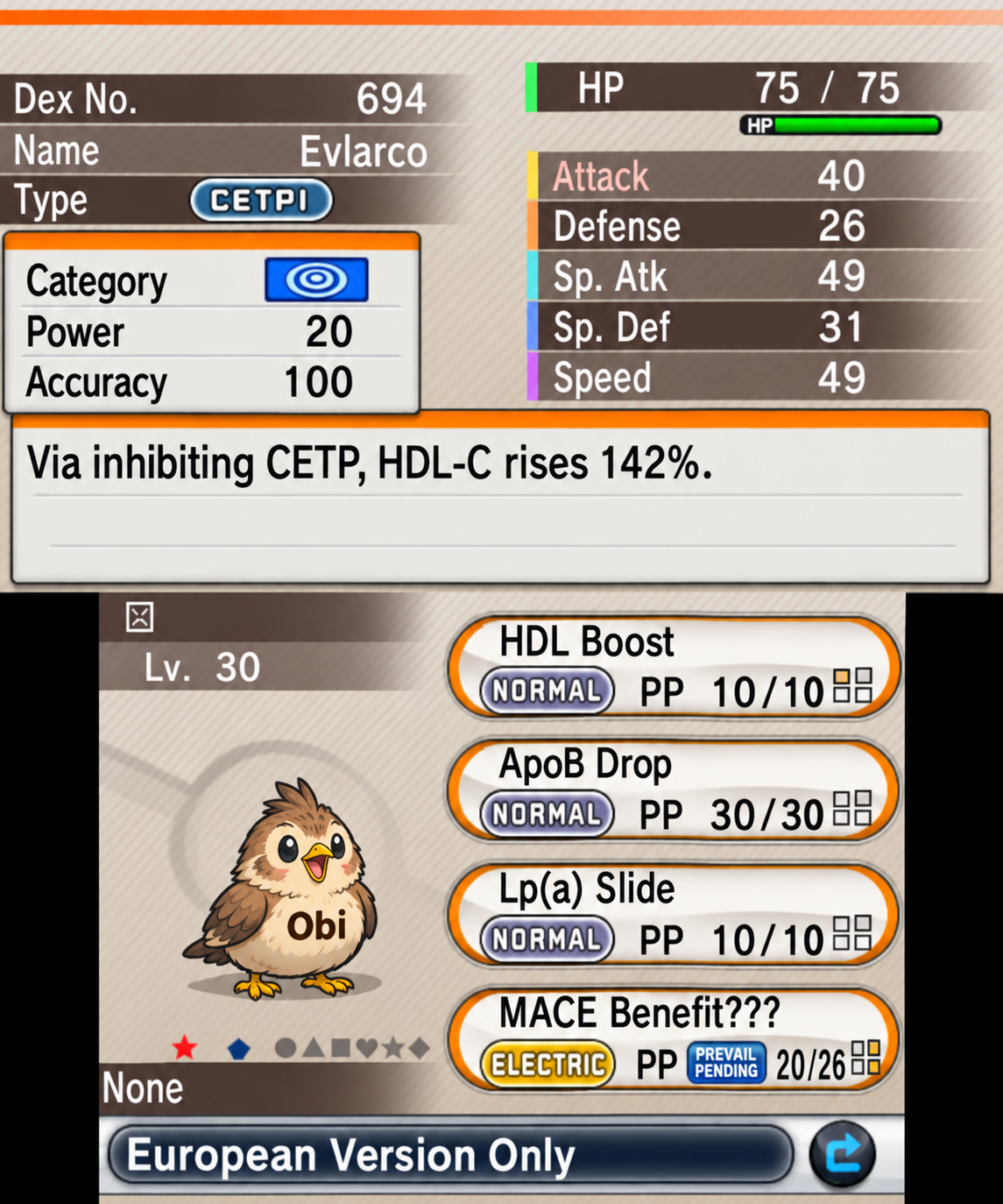
Most of you are familiar with the Pokemon video game series, but just in case, the basic premise of these games is you, the Pokemon Trainer, wander around catching “Pocket Monsters” such as Pikachu, (which is an Electric Type), and Diglett, (which is a Ground Type). (Ground would be “Super Effective” against Electric, whereas Electric would be “Super Effective” against a Water Type, etc). Then, you “train” these cuddly creatures by battling other trainers, which gives your Pokemon “Experience Points.” Once you get enough Experience Points, your Pokemon may “evolve” into stronger fighters, and ideally you will assemble a balanced and diverse team of creatures that can effectively match up with any other competitor. The goal is to defeat your “Rival” and eventually become a Pokemon Master like my daughter, whose knowledge of Pokemon is akin to my understanding of Lipid Biochemistry (pretty decent, I think).
There used to only be 151 of these critters, but now there are well over 1,000 (and my daughter informed me that there are even more coming in the near future)!
And quite hilariously, a few kindred spirits out there have made “Drugs or Pokemon?” videos, since many pharmaceutical and Pokemon names sound almost interchangeable…and it looks like we have a couple of new candidates for “Drugs or Pokemon?” as of this week!
And although there probably aren’t quite 151 Lipid-Modulating therapies these days, there are now at least two more…at least in Europe! Because Obicetrapib, an oral Cholesteryl Ester Transfer Protein (CETP) Inhibitor, has been granted marketing authorization by the European Commission!
Obicetrapib alone has been named Ubeslo, and when it “ezetimibevolves” it is called Evlarco (Obicetrapib combined in one pill with Ezetimibe).
This CETPi-type fighter has proven effective in reducing ApoB, lowering Lp(a), and raising HDL-C, but will this new Pokemon become part of the ideal Lipid-Lowering party in the ongoing quest to defeat the biggest rival (ASCVD)? Will it give dignity to the much-maligned class of CETP Inhibitors, which historically have been “Weak” against ASCVD? Could it even be part of the team that slays the Legendary Mythical Beast of Neurodegeneration? Stay tuned…the PREVAIL outcome trial should read out fairly soon, and further research is being conducted all the time!